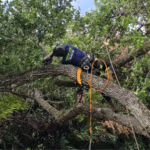
After lightning strikes a tree, our ISA-qualified arborists inspect the trunk, crown, root zone, and surrounding soil for visible and potential hidden damage. The evaluation helps determine whether your tree can remain in place safely, needs treatment and monitoring, or requires removal. Because lightning damage is not always immediately apparent, a consultation with our team can help you understand your tree’s condition and the appropriate next steps. A thorough professional inspection is more reliable than judging the tree by its appearance alone.
Why Does Lightning Damage a Tree Even When It Looks Fine?
Lightning can heat moisture inside a tree rapidly, creating steam that damages wood and separates bark. Some injuries are visible on the trunk, while others may affect internal tissues or roots. The University of Florida’s lightning research discusses the effects of lightning on trees and the potential for damage that is not immediately obvious.
Tall trees and those standing in exposed locations can be particularly vulnerable to lightning strikes. When a tree grows near your home, driveway, or other frequently used area, damage can create severe risks for your family and property. A tree may show little external damage immediately after a strike. Internal injury and decay can become more apparent over time, so the absence of a large scar does not automatically mean your tree is safe.
The tree’s species, size, condition, and location all influence how our arborists evaluate the damage. Our arborists also consider what could be affected if a branch or the entire tree fails.
What Should You Do Before the Arborist Arrives?
If lightning strikes a tree on your property, keep your distance until the area is safe and our professional team can assess the damage.
- When conditions allow:
- Keep people, pets, and vehicles away from the tree.
- Photograph visible damage from a safe distance.
- Do not pull away loose bark or attempt to cut broken or hanging limbs.
- Avoid approaching trees or branches that are touching power lines.
- If the tree has damaged a building, document the damage safely and contact your insurer as appropriate.
- For more warning signs to watch for, read our blog about ‘Spotting a dangerous, rotten tree before the next big Florida storm’.
Photographs taken before the strike can also help our arborists identify changes in the tree’s lean, canopy, or branch structure. If power lines are involved, contact your utility provider immediately and keep clear of the affected area.
What Do Our ISA Arborists Check First After a Strike?
Our ISA-qualified arborists in Vero Beach, Florida, begin by assessing immediate hazards and examining your tree’s overall condition. The inspection typically moves from the visible crown and trunk to the root zone and surrounding ground.
Our arborists look for:
- Bark damage: Scars, burn marks, or strips of missing bark that extend along the trunk.
- Separated bark: Areas where bark has loosened or pulled away from the underlying wood.
- Cracks and splits: Structural damage in the trunk or at major branch unions.
- Crown changes: Scorched, wilting, browning, or dying foliage.
- Broken branches: Dead or hanging limbs that could fall onto buildings, vehicles, or walkways.
- Changes in stability: A new lean, disturbed soil, or signs of root movement around the base.
Our arborists consider each finding in relation to the tree’s surroundings. For example, a damaged branch above an open lawn may present a different level of risk from a similar branch over your bedroom or driveway. Our blog about ’What to check after heavy rain and wind in Vero Beach’ explains how to identify trunk cracks, root movement, hanging limbs, and other signs of storm damage.
The ISA Tree Risk Assessment Qualification program provides professional training in evaluating tree risk. A professional tree risk assessment considers the likelihood of failure, the likelihood of a target being struck, and the potential consequences.
Why Does the Root Zone Matter After Lightning?
Lightning damage is not always limited to the visible trunk and canopy. Electrical current may travel through the tree and into the surrounding soil, potentially injuring roots and affecting the tree’s ability to take up water and nutrients.
- During the inspection, our arborists check for:
- Exposed or damaged roots.
- Lifted, cracked, or disturbed soil around the trunk.
- Changes in the tree’s stability or lean.
- Signs of decline that may indicate damage below ground.
Root injuries can be difficult to confirm through a visual inspection alone. However, soil disturbance and changes in stability can indicate a potential problem that requires further evaluation.
The root zone is particularly important when a large tree stands near your home, driveway, pool, or other occupied area. Our arborists use available evidence to determine whether additional investigation, monitoring, or urgent action is appropriate.
What Do the Findings Mean for Your Tree?
Our arborist’s recommendations depend on the extent of the damage, the tree’s structural condition, and the consequences of a potential failure. The outcome may involve monitoring, appropriate pruning or other treatment, further assessment, or removal.
| Finding | What It May Indicate | Potential Next Step |
| Narrow strip of missing bark | Possible lightning injury along the trunk | Assess the underlying wood and monitor the tree |
| Bark separating from wood | Possible internal tissue damage | Evaluate the affected area and check for deterioration |
| Large trunk split | Significant structural damage | Assess immediate risk and consider removal |
| Sudden crown browning | Possible injury to the crown or internal tissues | Evaluate the extent of damage and monitor changes |
| Heaved soil or exposed roots | Possible root damage or instability | Arrange prompt professional assessment, particularly near structures |
These findings are not definitive diagnoses on their own. A bark scar does not automatically mean your tree must be removed, and a tree without a large split is not necessarily safe. Our arborists consider all relevant observations before recommending a course of action.
How Does a Lightning Strike Affect Palms Differently?
Palm trees respond differently to lightning than broadleaf trees. Palms have a single growing point near the top of the trunk, so severe damage to this area can prevent further growth and may lead to the palm’s death.
- After a suspected strike, our arborists check for:
- Browning, wilting, or collapsing fronds.
- Damage to the crown or growing point.
- Visible trunk injuries.
- Changes in the palm’s stability or condition.
A palm may initially remain upright even when its growing point has suffered serious damage. Our arborists assess the available signs and explain whether monitoring or further action is appropriate.
On the Treasure Coast, palms frequently grow beside homes, driveways, and entrances. Their location matters when determining the consequences of a potential failure.
Why Do We Re-Inspect a Struck Tree Later?
Some effects of lightning damage become clearer over time. A tree may develop progressive crown dieback, bark separation, or signs of decay after the initial inspection. For this reason, follow-up assessments can be important when initial findings support monitoring rather than immediate removal. Learn more from our blog about Storm preparation for trees in Vero Beach which sheds light on how preventive maintenance can help address structural weaknesses before severe weather.
Our team can assess changes in your tree’s condition and recommend whether your original management plan needs to be revised. The timing of a follow-up depends on the severity of the injury, the species, the tree’s condition, and its location. For example, a tree with limited visible damage and no identified immediate hazard may be monitored. A tree with a worsening split, increasing lean, or other evidence of structural instability may require more urgent action.
Our arborists also determine whether your tree can remain safely in place or requires removal. If a damaged tree or limb presents an immediate hazard, our 24/7 emergency tree service can help address the situation.
If lightning strikes your tree, call (772) 404-3414 to discuss the damage and arrange an assessment. You can also request an estimate online.
Frequently Asked Questions
How soon should a tree be inspected after a lightning strike?
Arrange an inspection as soon as the area is safe to approach. Trees with major trunk splits, hanging limbs, sudden leaning, or damage near buildings need prompt attention. Stay away from unstable trees and anything touching power lines.
Will a tree with a lightning scar die?
Not necessarily. The outcome depends on the extent of the injury, the tree species, and whether the trunk, crown, or roots have sustained significant damage. Our arborists can assess the visible evidence and recommend monitoring or further action.
Is a tree safe if I see no damage after a storm?
Not always. Lightning injuries may not be immediately visible, and changes in your tree’s condition can develop later. If you suspect a direct strike, a professional assessment can help determine whether monitoring or further investigation is appropriate.
Should I prune a struck tree right away?
Only remove branches when it is safe and appropriate to do so, and leave hazardous limbs to trained professionals. Before arranging extensive pruning, have our arborists assess the damage. Unnecessary cuts can add further stress to an injured tree.
Does a tree’s height change its lightning risk?
Tall trees and trees in exposed locations can be more vulnerable to lightning strikes. However, the likelihood of a strike also depends on the surrounding landscape and storm conditions. A tree’s height alone does not determine whether it is safe after a storm.
Why does an ISA credential matter for lightning evaluations?
ISA credentials indicate that an arborist has met the requirements of the relevant professional certification. For a tree with possible structural damage, training in tree risk assessment can help the professional evaluate potential failure, nearby targets, and suitable management options.
Does Treasure Coast Tree & Land Services Provide Tree Services in Vero Beach, FL, and Surrounding Treasure Coast Communities?
Yes. Treasure Coast Tree & Land Services provides tree service in Vero Beach, FL, and surrounding Treasure Coast communities. Our services include arborist consultations, tree trimming and pruning, and emergency tree service for damaged or hazardous trees. Call (772) 404-3414 or contact our team to discuss your tree’s needs and request an estimate.