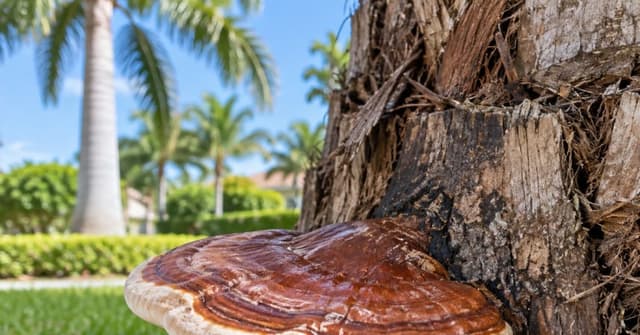
Ganoderma butt rot is a lethal palm disease caused by the wood-decaying fungus Ganoderma zonatum. There is no proven cultural or chemical cure once a palm is infected.
A palm with a confirmed Ganoderma conk should be removed promptly because substantial internal trunk decay may already be present. Removing the conk, fertilizing the palm, adjusting irrigation, or trimming declining fronds will not restore the damaged trunk.
General decline does not confirm Ganoderma. Nutrient deficiencies, lethal bronzing, Fusarium wilt, root problems, and other conditions may cause similar canopy symptoms. Accurate identification matters before you decide that a declining palm needs removal.
At Treasure Coast Tree & Land Services, we evaluate palms throughout Vero Beach, Indian River County, and surrounding Treasure Coast communities. Our team looks at the entire palm, its surroundings, and visible disease indicators before recommending the next practical step.
What Is Ganoderma Butt Rot?
Ganoderma butt rot is a fatal disease that breaks down structural tissue inside the lower trunk of a palm. It can affect palms growing in maintained landscapes as well as natural settings.
The disease is caused by Ganoderma zonatum, one of several fungi in the broader Ganoderma group. It should not be confused with medicinal Ganoderma products or mushrooms commonly called reishi.
Current University of Florida IFAS guidance considers all palm species possible hosts. Not every palm species used in Florida landscapes has a documented case, but no palm is considered reliably resistant.
The fungus primarily decays the lower part of the trunk. It breaks down components that help the trunk maintain strength and transport water. As the decay progresses internally, the palm may eventually lose enough structural support to become unstable.
Researchers have not identified environmental or management conditions that reliably predict which palms will become infected. Ganoderma has appeared in well-maintained landscapes, natural areas, wet sites, dry sites, and palms with different levels of care.
Florida humidity, rainfall, irrigation, poor drainage, pruning, and hurricane exposure should not be presented as direct causes. Those conditions may affect the palm in other ways, but current evidence does not establish them as the reason Ganoderma begins.
Can a Palm With Ganoderma Be Saved?
A palm with a confirmed Ganoderma butt rot infection cannot currently be cured. Early recognition allows safer planning, but it does not create a treatment window that can eliminate the fungus.
No proven fungicide can cure an infected palm. Fertilizer may correct a nutrient deficiency, but it cannot rebuild trunk tissue already destroyed by Ganoderma.
Several commonly suggested actions do not cure the disease:
- Removing the visible conk
- Cutting away declining fronds
- Applying fertilizer
- Changing irrigation schedules
- Improving drainage
- Applying a soil drench or home remedy
- Treating the trunk with an unproven product
Removing a conk may reduce additional spore production if it is handled properly, but the fungus remains inside the palm. A new conk may also develop later.
A declining palm without a conk should still be assessed. Another condition may be responsible, and some palm problems have management options. Our plant healthcare services address disease identification, nutritional concerns, pest problems, and other possible causes of decline.
What Does Ganoderma Do Inside a Palm?
Ganoderma weakens a palm by decaying internal tissue in the lower trunk. The damage can progress without producing an obvious soft spot or visible opening on the outside.
The fungus breaks down lignin and then cellulose within the trunk. These materials contribute to the palm’s structural integrity. As more tissue deteriorates, the lower trunk becomes less able to support the palm.
Internal decay generally begins near the soil line and progresses within the lower trunk. The deterioration may be widest near the base and become narrower farther upward.
A palm can appear relatively normal while this process continues. Its crown may still have green fronds even though important structural tissue has been lost below. Canopy appearance alone cannot show how much strength remains.
Visible decline may develop after internal damage affects water-conducting tissues. Even then, the severity of wilting or discoloration does not provide a reliable measurement of decay.
Which Palms Can Develop Ganoderma?
All palm species are considered potential hosts of Ganoderma zonatum. Property owners should not assume a palm is protected because of its species, age, value, or maintenance history.
The disease has been documented across many types of palms. It can occur in residential yards, commercial landscapes, managed communities, and natural settings.
A healthy-looking palm can still become infected. A poorly maintained palm is not automatically more likely to have Ganoderma, and a well-maintained palm is not guaranteed protection.
This uncertainty is one reason accurate observation matters. Palm care can support overall health, but no maintenance plan has been proven to prevent Ganoderma butt rot.
What Does a Ganoderma Conk Look Like?
A Ganoderma conk is the fungus’s spore-producing structure and usually develops on the lower portion of the palm trunk. Its appearance changes as it matures.
A developing conk may begin as a white, button-like mass attached directly to the trunk or stump. It can appear relatively soft and flat during this early stage.
As the conk develops, it projects outward and forms a shelf or bracket. A mature conk is usually hard and has a glazed reddish-brown upper surface with a white underside. It often has a half-moon shape and attaches directly to the palm without a central stalk.
The conk may release spores that leave a rusty or brownish-red dust on nearby surfaces. That dust should not be disturbed unnecessarily.
A conk on a living palm provides strong confirmation of Ganoderma butt rot. However, not every mushroom growing near a palm is Ganoderma. Other fungi may grow on mulch, roots, dead wood, or surrounding soil.
Do not taste or handle an unidentified fungal growth. If the identification is uncertain, take clear photographs from a safe position and request a professional arborist consultation.
Can a Palm Have Ganoderma Without a Visible Conk?
Yes, an infected palm may decline or die without producing a visible conk first. The absence of a conk does not prove that a palm is free of Ganoderma.
General canopy symptoms may include:
- Wilting
- Slower growth
- Off-color or dying fronds
- More dead lower fronds than expected
- Reduced canopy density
- An overall loss of vigor
- Weakness or movement near the base
These symptoms are not specific to Ganoderma. Nutrient deficiencies, Fusarium wilt, root damage, water stress, and other problems may produce similar changes.
Lethal bronzing is a separate palm disease with a different cause and disease process. Our guide to spotting lethal bronzing in Vero Beach palms explains those warning signs in greater detail.
Yellowing alone is especially unreliable. Florida palms frequently develop discoloration because of nutritional problems that require a different response from a fungal trunk disease.
How Is Ganoderma Diagnosed?
A visible conk attached to a living palm’s lower trunk provides the clearest confirmation before removal. General decline without a conk is not enough to diagnose Ganoderma butt rot.
Historically, internal discoloration and decay found after the palm was removed could also support the diagnosis. By that point, the information explains the loss but cannot save the palm.
A photograph may help a professional evaluate the shape and location of a fungal structure. An uncertain image does not provide the same level of confidence as an onsite assessment.
Do not drill into the trunk or collect sawdust without professional instructions. Unplanned sampling can damage the palm, create safety concerns, and still fail to produce useful information.
Our team can evaluate visible palm conditions and recommend an appropriate next step. We do not promise diagnostic certainty when the defining evidence is absent.
How Does Ganoderma Spread?
Ganoderma spreads primarily through spores produced by mature conks. Those spores can move through the environment, become incorporated into soil, and begin the fungal life cycle around palms.
The fungus may grow along palm roots to reach the lower trunk. This does not mean Ganoderma butt rot should be described as a root rot. The main structural decay occurs inside the lower trunk.
Scientists do not know exactly how long infection takes to produce a conk. There is also no reliable way to guarantee that a newly planted palm is free from infection when no conk or other confirming evidence is present.
Ganoderma is not considered a disease spread by palm-pruning tools because the fungus is associated with the lower trunk rather than the fronds. Tool sanitation remains useful for other palm diseases, but it should not be promoted as proven Ganoderma prevention.
Removing one infected palm also does not guarantee that the site is free of the fungus. Spores may already be present, and the fungus can remain associated with the soil and remaining palm material.
Nearby palms will not automatically become infected. Monitoring helps identify changes, but no chemical prevention program has been proven effective.
Why Does a Confirmed Palm Need Prompt Removal?
A palm with a confirmed conk should be removed because the conk indicates that significant internal decay may already exist. The palm can become structurally weaker even if the crown still looks partly green.
Strong winds do not cause Ganoderma, but they can place additional load on a trunk weakened by decay. This matters on the Treasure Coast, where palms commonly stand near homes, driveways, walkways, parking areas, and pool enclosures.
Keep people, vehicles, pets, and outdoor activities away from a confirmed or visibly unstable palm, especially if you notice:
- A Ganoderma conk on the lower trunk
- New leaning or visible movement
- Cracking near the base
- Rapid canopy decline
- A change in the palm’s position after strong winds
- A location within falling distance of an occupied area
A confirmed palm should not be climbed for routine trimming. Internal decay may make the trunk unsafe even when the exterior appears solid.
Professional palm and tree removal allows the work to be planned around the palm’s condition and surrounding property. Removal is a safety response to irreversible trunk decay, not a claim that the palm will fail on a particular day.
If the palm is already moving, leaning toward a structure, or damaged after a storm, contact our 24/7 emergency tree service. Stay away from any palm or tree touching a utility line and contact the utility provider first.
What Should Happen to the Stump and Infected Material?
For palms affected by Ganoderma butt rot, UF/IFAS recommends removing as much of the stump and root system as possible when the infected palm is removed. If complete removal is not practical, grinding the stump is recommended. Ganoderma butt rot of palms can provide additional disease-management guidance.
A stump that cannot be removed should be monitored for new conks. These shelf-like fungal structures produce spores that can spread the disease. Removing a new conk as soon as it forms may reduce additional spore production, but it does not eliminate the fungus from the remaining stump or soil. UF/IFAS also recommends monitoring palm stumps for Ganoderma conks after removal.
The lower infected trunk should not automatically be chipped and reused as landscape mulch. Infected palm material should be handled according to current disease-management recommendations and applicable local disposal requirements. The UF/IFAS guidance on Ganoderma disease in palms recommends removing or grinding the stump after an affected palm is cut down.
Our palm stump grinding service can be included in the removal plan or discussed separately. Grinding reduces the remaining stump material, but it should not be described as sterilizing the soil. UF/IFAS notes that the fungus can survive in soil, which is why planting another palm in the same location may remain problematic.
The site should continue to be checked after removal. New conks can develop on palm tissue left at or below the surface, so removing the visible palm does not necessarily eliminate all remaining fungal material.
Can You Plant Another Palm in the Same Location?
Planting another palm in the same location is generally not recommended because Ganoderma zonatum can remain associated with the site. Replacing the soil does not guarantee that the fungus has been removed.
No fungicide, soil drench, or landscape treatment has been proven to make the location safe for another palm. There is also no reliable waiting period after which replanting a palm becomes risk-free.
A non-palm replacement may be considered because Ganoderma zonatum is considered a pathogen of palms rather than other plant families. Plant selection should still account for available space, sunlight, drainage, utilities, nearby structures, and local landscape requirements.
A qualified professional can help you evaluate replacement options without promising that any living plant is completely free from future health problems.
How Should Nearby Palms Be Monitored?
Nearby palms should be checked regularly for conks, unexplained decline, and structural changes near the base. Monitoring cannot prevent infection, but it may help you recognize a problem before a weakened palm fails.
Look for:
- White button-like growths on the lower trunk or stump
- Hard, shelf-like conks
- Wilting or reduced canopy density
- Increasing numbers of dead fronds
- New leaning
- Cracks or movement near the base
- Changes that appear after wind or storm conditions
Inspect from the ground without striking, drilling, or cutting into the palm. A simple set of dated photographs can help you compare changes over time.
Continue checking a site where an infected palm was removed. Monitor remaining stumps and nearby palms without assuming that every declining palm has the same disease.
Our tree-care resources provide additional guidance for managing trees and palms in local landscapes. You can also review our Treasure Coast service areas to confirm coverage for your property.
Request a Professional Palm Assessment
Request an assessment if you find a conk, unexplained canopy decline, new leaning, or weakness near a palm’s base. A professional evaluation can help distinguish a confirmed Ganoderma infection from other palm problems with different management options.
Our team can inspect the visible condition and recommend the next practical step. We will not promise that a palm with confirmed Ganoderma can be treated because no proven cure currently exists.
If removal is necessary, we can plan professional palm removal and appropriate stump management for the site. Call Treasure Coast Tree & Land Services at (772) 404-3414 or request a palm assessment.