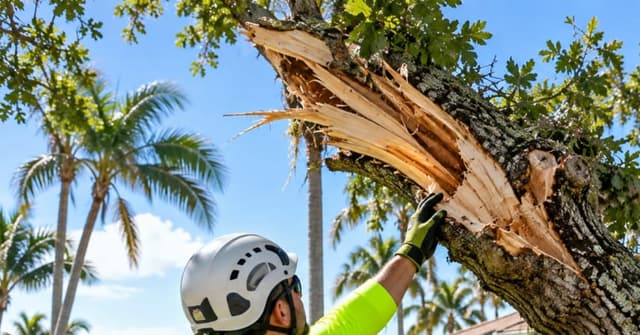
Once the weather clears, it’s natural to walk outside and see what changed. A careful look can reveal obvious damage, but some of the most serious tree problems are easy to miss from a window or driveway. A professional post-storm tree inspection in Vero Beach can identify structural damage, root movement, and palm crown problems before the next round of wind or rain puts more pressure on the property.
Vero Beach trees deal with tropical storms, hurricanes, isolated microbursts, lightning, coastal wind, and long periods of heavy rain. A tree may withstand the wind but shift in saturated sandy soil. A palm may remain upright while damage inside the crown affects new growth. Large hardwood limbs can crack without falling immediately.
You can make a useful first check from the ground if conditions are safe. Keep your distance, take clear photos, and note anything that looks different from before the storm. Do not climb a damaged tree, walk under hanging limbs, pull branches with a vehicle, or use a chainsaw on storm-damaged wood. Bent and twisted wood can hold tremendous tension and move without warning when cut.
Here’s what we recommend checking and when to call our team for a closer assessment.
Start With Immediate Hazards Before Inspecting Anything Else
Safety comes before cleanup. Before looking closely at a trunk or picking up small debris, scan the whole property from a protected location. Look above you, across the yard, and toward every usual access point.
Treat these conditions as immediate hazards:
- A tree, palm, or limb touching or hanging near a power line
- A tree resting on a roof, vehicle, fence, pool enclosure, shed, or other structure
- A split trunk or suspended limb above a driveway, sidewalk, doorway, play area, or parking space
- A fallen tree wblocking emergency access or the only safe way in or out
- An upright tree that is visibly moving at the base in light wind
- A tree that has partly fallen into another tree
- A broken utility pole, sparking line, or downed wire near tree debris
Assume every downed line is energized. Stay away, keep other people and pets out of the area, and contact the utility or emergency authorities first. Never touch a branch that is contacting a line. Moist wood, wet soil, and nearby metal fencing can expand the danger zone.
If a tree has damaged a structure, observe it only from a safe distance. Storm-loaded wood may be supporting weight in ways that aren’t obvious from the ground. Don’t enter a damaged area just to take photographs. If you can document the scene safely, photos from several distant angles may be helpful when you speak with our team or your insurance company.
For active hazards, blocked access, or a tree on a structure, call our 24/7 emergency line at (772) 404-3414. Our emergency service is intended for urgent situations that can’t safely wait for a routine appointment.
Check Root Plates and Sandy Soil for Signs of Movement
Heavy rain can change a tree’s stability even when the canopy looks intact. Vero Beach’s sandy soils can lose holding strength when saturated, especially after repeated rain bands. Wind then pushes against the canopy like a lever. The trunk may stay whole while the root plate shifts below it.
Stand well back and compare the tree with nearby vertical lines, such as a building corner or fence post. Look for:
- A new lean or a lean that has become more pronounced
- Soil lifting or mounding on one side of the trunk
- Fresh cracks radiating through the soil
- Depressions, gaps, or sunken areas on the opposite side
- Exposed, torn, or newly visible roots
- Water pooling around a root plate that has changed position
- Movement where the trunk enters the ground
Fresh soil movement often matters more than the angle alone. Some healthy trees naturally lean. A recently formed lean paired with lifted soil or root damage suggests that the anchoring system has shifted.
Do not press on the trunk, dig around the roots, or try to pull the tree upright. Keep people and vehicles outside its potential fall area. If the tree could reach a home, road, utility line, pool area, or neighboring property, contact our team promptly for a storm damage tree assessment in Vero Beach.
We look at the direction and extent of the lean, root plate movement, soil conditions, canopy weight, nearby targets, and signs of older root or trunk problems. That broader view helps determine whether the tree can be monitored, needs corrective work, or has become too unstable to retain.
Examine Trunks and Major Branch Unions From the Ground
Strong wind places concentrated force where large limbs meet the trunk and where two stems join. These unions may split during a gust and remain partly attached after the storm. Rain can also make old cavities, decay, or peeling bark easier to notice.
Use binoculars or the zoom on your phone rather than walking directly beneath the canopy. Check the main trunk and major unions for:
- Fresh vertical or horizontal cracks
- A seam that has opened between two main stems
- Torn wood or exposed light-colored tissue
- Bark peeling away in a new area
- A cavity that appears larger or newly opened
- A hollow section with fresh debris at its base
- One side of a fork pulling away from the other
- Dark fluid, loose bark, mushrooms, or soft wood around an injured area
- A lightning scar, shattered bark, or a strip of damaged tissue running down the trunk
Fresh damage often looks lighter than the weathered wood around it. A line in the bark may be harmless, but a crack that extends into the wood or opens when the tree moves can signal structural separation. Co-dominant stems, which are two trunks of similar size sharing one union, deserve particular attention after strong wind.
A trunk defect doesn’t automatically mean removal. Location, depth, surrounding wood, crown condition, and what the tree could strike all affect the decision. Our arborist consultation provides a closer evaluation when the right next step isn’t clear. If the split is widening, the tree is moving, or the defect is below a heavy stem over a target, stay out of the area and treat it as urgent.
Scan the Canopy for Broken, Hanging, or Twisted Limbs
Canopy damage can hide in plain sight. A branch may break high above the ground but stay lodged among other limbs. Wind-twisted branches can remain attached by a strip of wood and leaves, then fall later when the foliage dries, rain adds weight, or another gust arrives.
Walk only where you have clear overhead space. From a distance, look for:
- Hanging or partly detached limbs
- Freshly exposed wood at a broken stub
- Branches pointing at an unusual angle
- Limbs caught in neighboring trees
- A section of canopy that has dropped lower
- Twisted foliage or leaves facing a different direction from the rest of the crown
- A suddenly uneven or one-sided canopy
- Small debris continuing to fall after the wind has stopped
- Cracked limbs above roofs, driveways, pool cages, walkways, and parking areas
Don’t stand underneath a limb to judge its size. Don’t shake the tree or throw a rope over the branch. A seemingly manageable limb can be heavier than it looks and may be held under tension by adjacent wood.
Our team can determine whether damaged limbs can be removed through careful pruning or whether the storm exposed a larger structural problem. Proper cuts matter. Tearing a broken limb away or leaving a long damaged stub can create an additional wound and reduce the tree’s chance of closing the injury properly.
Inspect Palms Differently From Hardwood Trees
Palms and branching hardwood trees don’t respond to storms in the same way. A hardwood may split at a major branch union. A palm has one main growing point in the crown, so damage there can affect the entire plant. The flexible trunk of a palm may also bend in high wind without showing the type of cracks you would expect on an oak or pine.
From the ground, check each palm for:
- A crown that is tilted or no longer centered over the trunk
- A hanging crown section or large loose fronds
- A bent or snapped trunk
- New cracks, soft areas, or fresh damage near the base
- A spear leaf that is bent, loose, discolored, or missing
- Fronds broken close to the crown
- A palm that is leaning more than it did before the storm
- Soil lifting or opening around the base
Some frond loss is visible right away. Damage to the growing point may take longer to show. Watch the newest central growth during the following weeks. A crown that stops producing normal new growth, a spear leaf that loosens, or rapid discoloration deserves professional attention.
Do not pull loose fronds from below or cut storm-damaged fronds while standing under the crown. Palm fronds are heavy, and damaged crown material can release suddenly. Our palm specialists assess the trunk, base, crown, remaining frond attachment, and recovery potential before recommending pruning, monitoring, treatment, or removal.
Look Closely at Trees Near Structures and Property Features
The same defect carries a different level of risk depending on what is within reach. A damaged limb over an open corner of a large yard is not the same situation as one over a bedroom, pool enclosure, driveway, or busy sidewalk.
Give extra attention to trees and palms near:
- Roofs, gutters, and exterior walls
- Pool cages, patios, and screened enclosures
- Driveways, parked vehicles, and boat storage
- Fences, sheds, detached garages, and play equipment
- Utility service lines and meters
- Septic areas, drainage features, and irrigation equipment
- Public sidewalks, streets, and neighboring property
Check for branches that have shifted closer to a structure, fresh contact marks, damaged roofing, bent enclosure framing, or roots that have lifted pavement. Salt-laden coastal wind can strip foliage and add stress, while lightning may leave damage that extends from the crown down through the trunk. A tree doesn’t have to fall completely to create a costly or dangerous situation.
Avoid moving a vehicle or equipment beneath a damaged canopy. If a tree is pressing against a fence or building, don’t try to pull it free. The contact point may be holding part of the tree’s weight. Releasing that support can change the direction of movement instantly.
During an assessment, we consider both the condition of the tree and the consequences of failure. That includes the size and position of damaged parts, the frequency of use below them, access for safe work, and the structures or utilities within reach.
Watch for Delayed Signs in the Days and Weeks After the Storm
The first clear day doesn’t always tell the whole story. Florida’s year-round growing conditions can make changes visible quickly, but internal damage and root stress may take days or weeks to appear. Continue observing from a safe location, especially after another heavy rain or windy afternoon.
Delayed warning signs include:
- Leaves wilting, browning, or dropping on one side of a tree
- A section of canopy that stops producing normal growth
- Branch tips dying back after appearing healthy at first
- Bark cracking or loosening around a storm wound
- Sap flow, dark staining, fungal growth, or insects around damaged wood
- A crack that widens or a union that opens farther
- Increasing lean or new soil movement at the base
- A palm spear leaf that pulls loose or fails to develop normally
- Fronds collapsing around a palm crown
- Repeated branch drop during calm weather
Heat, wind, and salt exposure can cause leaf burn that looks dramatic but doesn’t always mean the tree is structurally unsafe. On the other hand, a green canopy doesn’t prove the roots or trunk are sound. Structural damage and plant health are related, but they aren’t the same question.
Take dated photos from the same safe location so changes are easier to compare. If decline is spreading, the tree is moving, or new cracks appear, request an assessment rather than waiting for another storm to test the damaged structure. University of Florida IFAS Extension provides additional guidance on assessing hurricane-damaged trees and deciding what to do.
Florida’s Division of Emergency Management also recommends checking trees after hurricanes for cracks, leaning, damaged major limbs, decay, mushrooms, insect activity, and conflicts with power lines. See the Florida hurricane guide for evaluating tree hazards.
Know When the Situation Needs Urgent Help
Call for urgent assistance when a tree is on a structure, blocking critical access, actively shifting, or holding large broken sections over an occupied area. A severe trunk split, lifted root plate, or suspended limb can also require immediate attention even if nothing has fallen yet.
If power lines are involved, stay away and contact the utility first. OSHA recommends treating downed electrical conductors as energized and warns that they can energize nearby trees, fences, water, and other objects. Follow OSHA’s tree-trimming and downed power-line safety guidance before any storm-damaged tree work begins. Our team should not be the first call for an energized electrical hazard. Once the utility has addressed the line and confirmed the area is safe for tree work, we can evaluate and handle the tree-related damage.
Keep children, pets, tenants, customers, and visitors away from the affected area. Use a different door, parking spot, or walkway if possible. Don’t rely on caution tape alone if a limb could reach beyond the marked space.
For a fallen tree or urgent storm hazard in Vero Beach and the surrounding Treasure Coast, call our 24/7 emergency tree service at (772) 404-3414. Tell us what happened, what the tree is touching, whether access is blocked, and whether utilities are involved. Clear photos taken from a safe location can help us understand the scene.
Post-Storm Tree Inspection Vero Beach: What We Assess
A professional assessment goes beyond counting broken branches. Our ISA Certified Arborists evaluate how the storm affected the whole tree or palm and how that damage changes risk around the property.
Depending on the situation, we may examine:
- Root plate stability and recent soil movement
- Trunk condition, cavities, cracks, and storm wounds
- Major branch unions and co-dominant stems
- Broken, lodged, or overloaded canopy sections
- Palm trunks, crowns, spear leaves, and root stability
- Previous pruning, decay, disease, or insect activity that may affect recovery
- Proximity to homes, pool enclosures, utilities, vehicles, and access routes
- The likelihood and consequences of additional failure
- Whether the tree can be pruned, treated, monitored, or should be removed
Not every storm-damaged tree needs to come down. Some trees can be made safer with targeted pruning. Others need time and follow-up monitoring. Removal may be the responsible choice when root anchorage has failed, the trunk or primary union has suffered severe damage, or the remaining structure creates an unacceptable hazard.
We explain what we see and recommend work based on the actual condition of the tree. If written documentation is needed for an insurance claim, real estate matter, HOA issue, or another formal purpose, ask about an arborist consultation and the appropriate report scope.
Recommended Next Steps After Your Ground-Level Check
Once immediate hazards are controlled, organize what you observed. A short record makes the professional visit more efficient and helps you track delayed changes.
- Photograph each concern from a safe, consistent location.
- Note when the storm occurred and when you first saw the damage.
- Record any new lean, soil movement, cracking, falling debris, or crown changes.
- Keep people and property away from possible fall zones.
- Contact the utility first if any line may be involved.
- Request urgent service for active hazards or a scheduled assessment for uncertain damage.
- Continue watching undamaged-looking trees for delayed decline over the next several weeks.
Don’t begin pruning simply because a branch is reachable. Storm debris can be loaded, twisted, pinned, or supported by another limb. A chainsaw cut in the wrong place can release that force toward the operator, a structure, or a bystander. Ground-level observation and documentation are the safe homeowner tasks. Cutting, climbing, rigging, and removing unstable wood belong with trained tree professionals.
Frequently Asked Questions About Post-Storm Tree Inspections in Vero Beach
What should I check first after heavy rain or strong winds?
Start by looking for immediate safety hazards from a protected location. Check for fallen or hanging limbs, trees leaning toward structures, split trunks, lifted soil around the roots, and trees or branches near power lines. Do not walk beneath damaged trees or attempt to move storm debris that may be under tension. If electrical lines are involved, contact the utility first.
How can I tell if a tree became unstable after a storm?
Look for changes that were not present before the storm, including a new or increasing lean, lifted or mounded soil, cracks in the ground near the trunk, newly exposed roots, or movement where the trunk enters the soil. These signs can indicate that the root plate has shifted, particularly after prolonged rain has saturated sandy soil.
Does a leaning tree always need to be removed?
No. Some healthy trees naturally grow at an angle, so a lean by itself does not necessarily mean a tree is unsafe. A newly developed lean combined with root damage, lifted soil, trunk defects, or other structural changes is more concerning. An arborist can evaluate the tree’s root stability, canopy weight, structural condition, and what could be damaged if the tree fails.
Can a storm-damaged tree be saved?
In many cases, yes. Not every storm-damaged tree needs to be removed. Depending on the extent and location of the damage, targeted pruning, monitoring, tree healthcare, or other corrective measures may be appropriate. Removal may be recommended when severe root, trunk, or primary structural failure makes retaining the tree unsafe.
Should I remove broken or hanging branches myself?
Storm-damaged branches should not be treated like ordinary yard debris. Broken wood may be twisted, pinned, suspended, or under significant tension. Cutting the wrong section can cause a branch or trunk to move suddenly. Homeowners can safely observe and photograph damage from the ground, but climbing, chainsaw work, rigging, and removing unstable wood should be left to trained tree professionals.
What should I check on palm trees after a storm?
Look for a tilted crown, loose or hanging fronds, a bent or damaged trunk, changes around the base, and problems with the central spear leaf. Some palm damage may not become obvious immediately, so continue watching new growth during the weeks after the storm. A loose spear leaf, rapid discoloration, or abnormal new growth can warrant professional attention.
Can tree damage appear days or weeks after a storm?
Yes. Root stress and internal damage are not always visible immediately. Watch for increasing lean, widening cracks, dying branches, abnormal leaf loss, fungal growth around damaged areas, repeated branch drop, or changes in palm crowns during the following days and weeks. Taking dated photos from the same location can make these changes easier to identify.
When is storm-damaged tree removal considered an emergency?
A situation may require urgent attention when a tree is resting on a structure, blocking critical access, actively shifting, or holding large broken sections over an occupied area. Severe trunk splits, lifted root plates, and suspended limbs can also create immediate hazards. If power lines are involved, stay away and contact the utility before arranging tree work.
What does a professional post-storm tree inspection include?
Our ISA Certified Arborists may evaluate root stability, soil movement, trunk cracks and cavities, major branch unions, broken or lodged limbs, palm crowns, previous decay or disease, and the tree’s proximity to homes, vehicles, utilities, and other property features. Based on those findings, we can determine whether pruning, treatment, monitoring, or removal is appropriate.
Who should I call for a post-storm tree inspection in Vero Beach?
Treasure Coast Tree & Land Services provides tree trimming, tree removal, palm services, arborist consultations, hurricane preparation, and 24/7 emergency tree service in Vero Beach and surrounding Indian River County communities. Call (772) 404-3414 to request a free estimate for recommended tree work or discuss the appropriate assessment for your property.
Our Recommended Next Steps After an Inspection
The right recommendation depends on what failed, what remains stable, and what could be affected if the condition worsens. A sound tree with limited damage may need only monitoring. If a broken limb can be removed without compromising the remaining crown, targeted pruning may be enough.
Other findings may call for corrective pruning, palm or tree healthcare, structural support where appropriate, or follow-up monitoring through the next growth cycle. When a tree has suffered severe root, trunk, or crown failure, we may recommend scheduled removal or emergency removal based on the level of risk. Debris cleanup can be included when storm-damaged wood needs to be removed from the property.
Our team will explain why a recommendation fits the condition we found. We won’t treat every damaged tree or palm as a removal. The goal is to address the hazard, protect the surrounding property, and retain a viable tree when that can be done responsibly.
Schedule a Post-Storm Tree Inspection in Vero Beach
If heavy rain, a microburst, tropical storm, or hurricane has changed the trees or palms around your property, we can help you understand what needs attention now and what can be monitored. Our team serves Vero Beach and surrounding Indian River County communities with tree trimming, tree removal, palm services, arborist consultations, hurricane preparation, and 24/7 emergency tree service.
Call Treasure Coast Tree & Land Services at (772) 404-3414 to request a free estimate for recommended tree work or to discuss the right assessment for your property. If the situation is urgent, tell us immediately so we can direct the call appropriately.