A tree on the ground in your yard is a different problem than a tree still standing, and the difference matters more than most homeowners realize until they’re standing in the driveway after a storm wondering what to do next. A fallen tree has already done what trees aren’t supposed to do, and whatever brought it down – saturated root zone, weak union, hurricane wind, internal decay that finally caught up with the trunk – also means the tree is now resting under loads it wasn’t designed to hold, in positions where the wood is twisting, splitting, and waiting to release that stored energy the moment something disturbs it. That is the part of fallen tree removal that gets people hurt. Cutting into a downed tree without understanding where the tension is sitting is one of the most consistent ways homeowners and well-meaning neighbors end up in the emergency room across Florida, and across the Treasure Coast specifically after every named storm that comes through.
Treasure Coast Tree & Land Services handles fallen tree removal across Vero Beach and the surrounding Indian River communities, and this guide walks through what fast, safe removal actually looks like – why the speed matters as much as the safety, and what homeowners should do between the moment the tree comes down and the moment a real crew arrives.
Why Speed Matters on a Fallen Tree
Fallen trees create cascading problems the longer they sit, which is why most experienced tree services treat them as time-sensitive jobs rather than routine cleanups. When a tree comes down on a structure, the most obvious issue is the damage already done, but the less obvious issue is that the longer the tree sits there, the worse that damage gets. Roof shingles that took the initial impact will keep flexing under the weight of the wood, working the underlayment loose and creating leaks that weren’t there in the first hour. Water from the next storm – and on the Treasure Coast, the next storm is rarely more than a few days away during the summer – finds those compromised areas and starts running into the attic, the insulation, and the drywall. What started as a roof repair becomes a roof repair plus interior remediation plus mold treatment, and the insurance claim that should have been straightforward becomes a months-long ordeal.
Even when the tree fell into open yard space without hitting anything, speed still matters more than it appears. A downed tree blocks access for landscapers, repair contractors, and emergency services, and depending on where it landed, it can damage irrigation lines, septic field drains, and pool decking simply by lying on them. Trees that come down with their root plates partially exposed often have one or more major roots still anchored, which means the trunk is under load and can shift unexpectedly when the soil dries out or the next rain saturates things again. Removing the tree promptly is almost always cheaper than waiting and dealing with the secondary problems that develop.
What Makes Fallen Tree Removal Genuinely Dangerous
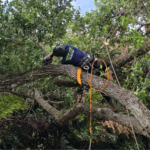
The reason fallen tree removal is one of the highest-injury jobs in the tree care industry – higher even than climbing intact trees, by most safety statistics – comes down to one word that doesn’t show up much in casual conversation about chainsaws, and that word is tension. A standing tree’s weight runs cleanly down through the trunk into the root system, and the wood is mostly in compression. When that tree falls and ends up resting against a structure, against another tree, across a fence, or supported only at a few points along its length, the weight is no longer running downward in a predictable way. Instead, the trunk and limbs are bent under loads they weren’t designed for, with one side of any given log compressed and the opposite side stretched. That stretched side stores enormous amounts of energy, and the moment a chainsaw cut releases it, the wood can spring violently, pinch the saw, kick the bar, or send a section of trunk rolling in a direction nobody expected.
This is the part of fallen tree removal that experienced crews train for and that uninsured operators with a borrowed chainsaw almost never understand until something bad happens. Reading the tension in a downed tree – figuring out which side is compressed, which is stretched, where to make the first cut, how to relieve pressure progressively without pinching the saw, when to walk away and bring in a crane instead – is the actual skill behind professional storm cleanup work. The cutting itself is the easy part.
How We Approach a Fallen Tree Job
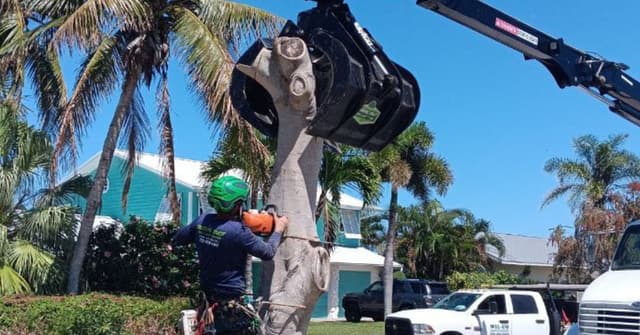
Every fallen tree removal we handle starts with the same first step, which is to walk the situation and figure out what we’re actually looking at before any equipment runs. The crew identifies where the tree is anchored, where it’s resting, what’s underneath it, what’s at risk, and where the tension is sitting in the wood. Trees on structures require the most planning, because the goal is to get the tree off the building without doing additional damage in the process, and the answer is almost always crane-assisted removal – picking sections up cleanly with a crane and setting them down in a clear area instead of cutting them free and hoping they fall in a safe direction.
Trees that have come down into open yard space, away from structures, can usually be handled more conventionally, though they still require careful cutting to relieve tension before the trunk and major limbs are sectioned for removal. Trees that have fallen across fences, across driveways, into pool enclosures, or that have taken down power lines on the way down each have their own considerations. The one thing that’s consistent across all of them is that the plan comes first, the equipment matches the plan, and the cuts get made in the order that releases stored energy progressively rather than all at once.
Common Fallen Tree Situations on the Treasure Coast
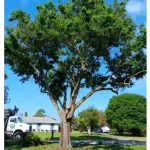
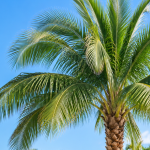
Certain fallen tree scenarios come up over and over in Vero Beach and the surrounding communities, and each one calls for slightly different handling. Sabal palms and queen palms that snap mid-trunk in high wind are extremely common, and the broken section often ends up dangling in the lower canopy where it has to be lowered with rigging or removed by climber. Mature live oaks and laurel oaks that uproot in saturated soil during tropical storms are another regular call, and these are typically larger jobs because the root plate alone can weigh thousands of pounds. Trees that come down across multiple properties – your tree on a neighbor’s fence, or the neighbor’s tree across your driveway – bring their own complications around access, communication, and sometimes shared insurance coordination.
What Homeowners Should Do Before the Crew Arrives
There are a few practical steps worth taking between the moment you call us and the moment our crew shows up, and they make a real difference in how smoothly the rest of the job runs. Take photographs and video of the fallen tree from multiple angles before anything moves, because insurance adjusters need that documentation and the more thorough it is, the cleaner the claim runs. Keep family members and pets well clear of the damage area, including children who tend to be drawn to the spectacle of a fallen tree in the yard. Move any vehicles that can be moved safely, without driving over downed wires or under hanging branches. If a tree has come down on a structure and rain is in the forecast, tarping the damaged area can buy you time, though it’s safer to tarp from inside the attic when the roof itself is unstable. Call your homeowners insurance company to start the claim process if a structure was hit, since most policies have 24-hour reporting requirements and earlier reporting almost always makes the claim run more smoothly.
What Not to Do
Equally important is what to avoid, and the biggest item on that list is the impulse to start cutting the tree yourself. Even small downed limbs can have tension stored in them in surprising ways, and a homeowner with a chainsaw is the single most common injury statistic in storm-related tree work across Florida. Anything resting against a power line, anything appearing to be in contact with electrical service drops, anything where you can hear wood cracking or settling under its own weight – those are situations to walk away from and wait for the professionals. The other major thing to avoid is signing anything from the door-knocking crews that show up across Vero Beach and the Treasure Coast within hours of every major storm. Some of those crews are legitimate, but many are not, and the cheap pricing they offer almost always comes with no insurance, no license, and no recourse if something goes wrong on your property.